CIM Specialist Award in AI Marketing
Comprehensive specialist training in artificial intelligence for marketing, covering AI fundamentals, machine learning applications, chatbot implementation, data ethics, customer journey optimization, and the future of AI in marketing strategy.
Official Diploma
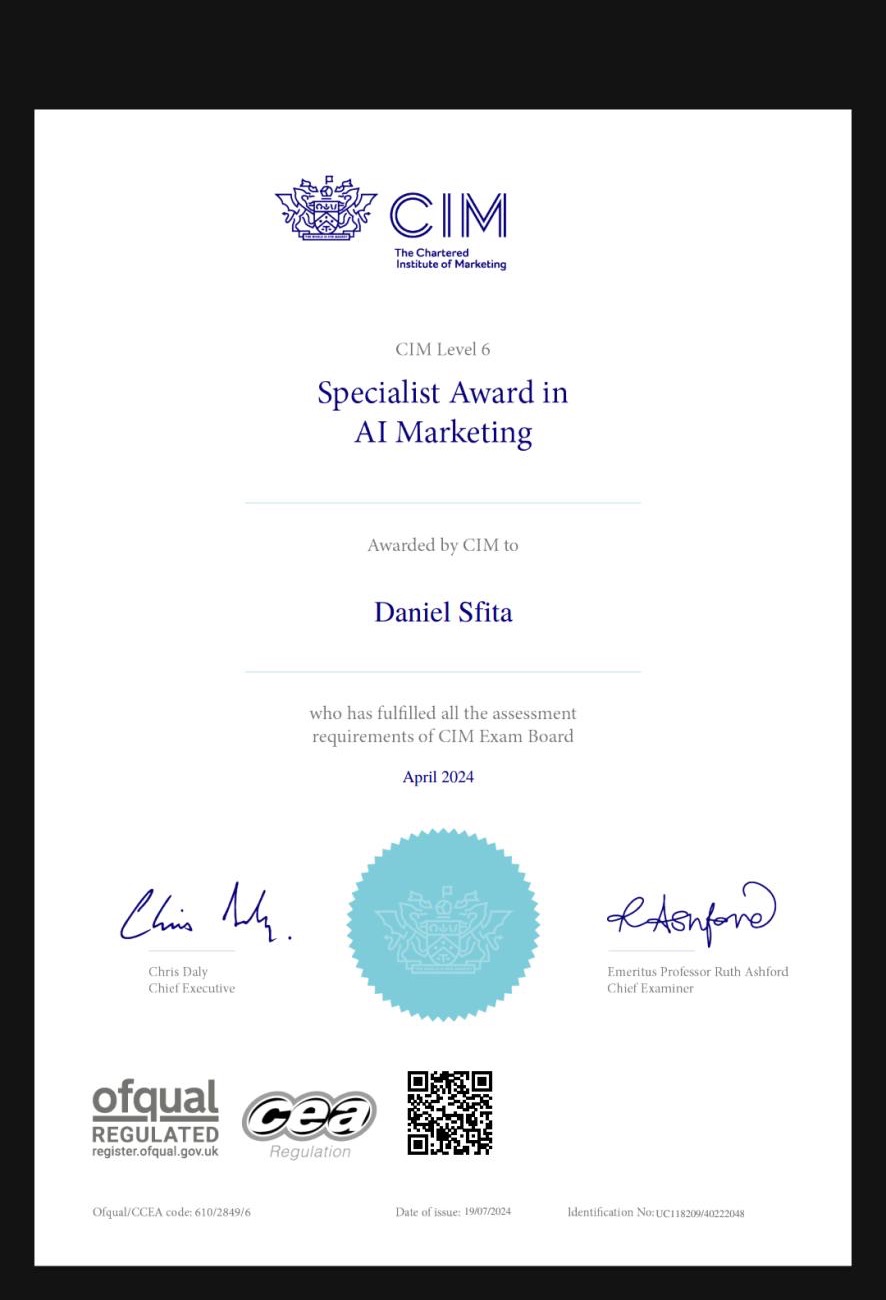
Program Overview
The CIM (Chartered Institute of Marketing) Specialist Award in AI Marketing is a prestigious qualification designed for marketing professionals seeking to master artificial intelligence applications in modern marketing. This intensive 6-month program combines theoretical knowledge with practical implementation, covering everything from AI fundamentals to advanced applications in customer journey optimization.
The program is structured around five core modules delivered through interactive podcasts, case studies, and hands-on projects. Each module builds upon the previous, creating a comprehensive understanding of how AI is transforming the marketing landscape and how professionals can leverage these technologies responsibly and effectively.
Key Learning Objectives
- AI Fundamentals: Understanding artificial intelligence, machine learning, and deep learning concepts essential for marketing applications
- Practical Implementation: Learning to deploy AI-powered tools like chatbots, predictive analytics, and personalization engines
- Data Strategy: Mastering data collection, quality assurance, privacy compliance, and ethical AI use
- Customer Experience: Optimizing the customer journey through AI-driven insights and automation
- Future Readiness: Preparing for emerging AI trends and maintaining competitive advantage in an AI-driven marketing landscape
Module 1: AI Definitions & Fundamentals
The foundation module introduces essential AI concepts that every marketer needs to understand. This module demystifies artificial intelligence and provides a practical framework for understanding how AI technologies work and how they can be applied to marketing challenges.
Core Concepts Covered
Artificial Intelligence (AI)
- Simulation of human intelligence by machines
- Narrow AI vs. General AI
- Applications in pattern recognition and prediction
- Decision-making optimization
Machine Learning (ML)
- Supervised learning with labeled datasets
- Unsupervised learning for pattern discovery
- Reinforcement learning through rewards/penalties
- Consumer behavior prediction
Natural Language Processing (NLP)
- Understanding and interpreting human language
- Sentiment analysis for brand perception
- Customer feedback interpretation
- Social media monitoring and insights
Deep Learning
- Multi-layer neural networks
- Complex pattern recognition
- Image and speech recognition
- Visual and voice search applications
Predictive Analytics
- Forecasting future customer behavior
- Product recommendation engines
- Churn prediction and prevention
- Campaign performance optimization
Chatbots & Conversational AI
- AI-powered customer interactions
- 24/7 customer engagement
- Personalized recommendations
- Purchase facilitation and support
Key Takeaway
Understanding these AI terms is crucial for modern marketers looking to stay ahead. While AI is a powerful tool, it's not a replacement for creativity, strategy, and the human touch. Successful marketing still requires the human element—interpreting AI insights and using them to create compelling, personalized experiences for your audience.
Module 2: Chatbots in AI-Powered Marketing
This module provides an in-depth exploration of chatbots as a transformative marketing tool. From basic scripted responses to sophisticated conversational agents powered by NLP and machine learning, chatbots represent a fundamental shift in how brands engage with customers at scale.
Evolution of Chatbots
Chatbots have evolved from simple pre-defined conversation paths to sophisticated AI agents that understand context, learn from interactions, and deliver increasingly personalized experiences. Natural Language Processing (NLP) and Machine Learning (ML) enable modern chatbots to comprehend human intent and respond intelligently.
Why Chatbots Matter for Marketers
Enhanced Customer Engagement
- Real-time query responses
- Product information and guidance
- Sales funnel navigation assistance
- Increased satisfaction and conversion rates
Personalization at Scale
- Customer data-driven interactions
- Behavioral pattern analysis
- Tailored messages and recommendations
- Enhanced loyalty through customization
24/7 Availability
- Round-the-clock customer interaction
- Global marketplace support
- Cross-timezone accessibility
- Consistent brand experience
Cost-Efficiency
- High-volume inquiry handling
- Reduced customer support team requirements
- Budget optimization for small businesses
- Resource allocation efficiency
Data Collection & Analysis
- Customer insight gathering
- Preference and behavior tracking
- AI-powered data analysis
- Actionable marketing intelligence
Automation & Efficiency
- Routine task automation
- Appointment scheduling
- Order tracking and account management
- Team focus on high-value activities
Implementation Best Practices
- Lead Qualification: Pre-qualify leads through relevant questions and response-based segmentation, optimizing sales team efforts
- Continuous Learning: Leverage AI's ability to learn from interactions, adapting to trends and evolving customer preferences in real-time
- Balance Automation & Human Touch: Maintain equilibrium between AI efficiency and personalized human interaction to avoid customer alienation
- Brand Alignment: Ensure chatbot personality and responses align with brand values and voice for consistent customer experience
Module 3: Data Ethics & Privacy in AI Marketing
This critical module addresses the ethical and legal considerations of using data in AI-powered marketing. As AI relies heavily on customer data, understanding privacy regulations, bias mitigation, and responsible data practices is essential for modern marketers.
Critical Data Issues
Data Privacy & Compliance
- GDPR and CCPA compliance requirements
- Customer data handling best practices
- Robust consent mechanisms
- Data anonymization techniques
- Regular legal updates and training
Bias in AI Algorithms
- Identifying biased training data
- Auditing algorithms for fairness
- Preventing demographic discrimination
- Promoting diversity and inclusivity
- Ethical targeting practices
Transparency & Trust
- Explainable AI models
- Clear data usage communication
- Building consumer trust
- Avoiding "black box" algorithms
- Transparent decision-making processes
Data Quality & Accuracy
- "Garbage in, garbage out" principle
- Data quality solution investments
- Regular data auditing and cleaning
- Reliable and current datasets
- Accurate AI-generated insights
Security Risks
- Cyber-attack protection
- Unauthorized access prevention
- Data breach mitigation
- Encryption and access controls
- Regular security audits
Ethical Responsibility
- Responsible AI implementation
- Societal impact consideration
- Ethical campaign development
- Individual privacy protection
- Long-term trust building
Data Sources for AI Marketing
- Internal Customer Data: Company databases with interaction history, purchase behavior, and browsing patterns (ensure GDPR compliance)
- Third-Party Data Providers: Aggregated anonymized data from vendors covering demographics, online behavior, and purchasing patterns
- Social Media & Public Databases: Publicly available data for social listening, trend analysis, and sentiment tracking
- Surveys & Direct Feedback: Customer surveys, reviews, and feedback forms providing direct insight into satisfaction and preferences
- Collaborations & Partnerships: Shared or pooled data from industry partners (with clear privacy terms and compliance)
Ethical Framework
Marketers have a dual responsibility: driving successful campaigns while maintaining ethical standards. This includes data privacy compliance, bias mitigation, transparency in AI use, data quality assurance, and security protection. Responsible AI implementation builds long-term customer trust and brand reputation.
Module 4: AI Impact on the Customer Journey
This module explores how AI is fundamentally transforming each stage of the customer journey—from initial awareness through consideration to final purchase decision. While the core journey stages remain intact, AI optimizes and enhances every touchpoint with personalization, prediction, and automation.
Customer Journey Transformation
AI doesn't replace the traditional customer journey but rather optimizes each stage, making interactions more efficient, effective, and personalized. The awareness stage now leverages AI-powered targeted advertising and content recommendations. During consideration, AI provides customized product suggestions based on behavioral analysis. At the decision stage, AI streamlines purchasing through personalized offers and frictionless transactions.
AI-Powered Tools Enhancing the Journey
Chatbots for Instant Engagement
- 24/7 customer availability
- Instant query responses
- Purchase assistance and guidance
- Enhanced satisfaction through immediacy
Predictive Analytics
- Future behavior forecasting
- Purchase pattern prediction
- Churn risk identification
- Proactive strategy development
Personalized Email Marketing
- Optimal timing and frequency
- Relevant content delivery
- Increased open and click-through rates
- Improved conversion performance
Voice Search & Smart Assistants
- Alternative search pathways
- Voice-optimized content strategy
- Smart assistant integration
- Bypass of traditional web browsing
Hyper-Personalization
- Individual-level customization
- Behavioral segmentation
- Preference-based targeting
- Enhanced engagement and conversion
Omnichannel Integration
- Seamless cross-channel experience
- Online and offline synchronization
- Consistent messaging and branding
- Unified customer view
Key Implementation Challenges
- Data Privacy Concerns: Extensive customer data use requires strict compliance with privacy laws and transparent communication about data usage
- Over-Reliance on AI: Balance automation with human judgment to maintain authentic customer relationships and avoid losing the human touch
- Implementation Costs: Initial investment and ongoing expenses can be barriers, especially for SMEs—assess budget and ROI expectations carefully
- Algorithmic Bias: Historical data biases can perpetuate discrimination—continuous monitoring and adjustment of AI systems is essential
Future Vision
AI will continue to refine the customer journey with increasingly sophisticated algorithms that integrate various touchpoints seamlessly. Marketers must remain adaptive and agile, staying updated with AI advancements, understanding evolving customer preferences, and aligning AI strategies with business objectives to deliver enhanced, personalized customer experiences.
Module 5: The Future of AI in Marketing
The final module explores emerging AI trends and prepares marketers for the next wave of innovation. Understanding where AI is headed helps marketers stay competitive and position themselves strategically in an increasingly AI-driven landscape.
Emerging AI Trends in Marketing
Hyper-Personalization
- Individual-level campaign customization
- Unprecedented targeting precision
- Messages feeling uniquely crafted
- Significantly higher engagement rates
Advanced Chatbots
- Increasingly human-like interactions
- Sophisticated natural language understanding
- Enhanced customer service quality
- Improved user experience and satisfaction
Refined Predictive Analytics
- Greater behavior forecasting accuracy
- Trend anticipation capabilities
- Proactive marketing strategies
- Data-driven decision optimization
AI-Generated Content
- Automated content creation at scale
- Personalized messaging generation
- Increased relevance and engagement
- Cost-effective content production
Voice Search Optimization
- Voice assistant integration strategies
- Conversational keyword optimization
- Natural language query adaptation
- Audio-first content development
Enhanced Data Security
- AI-powered threat detection
- Real-time security monitoring
- Privacy protection automation
- Cyber threat prevention
Staying Ahead: Strategic Recommendations
- Cultivate Continuous Learning: Dedicate time to understanding AI technologies through workshops, webinars, and industry conferences
- Invest in AI Education: Complete online courses tailored for marketers covering AI fundamentals and practical applications
- Collaborate with AI Experts: Partner with data scientists and AI specialists to gain deeper understanding of capabilities and implementation
- Experiment Fearlessly: Conduct pilot projects and A/B testing to understand AI impact on engagement, conversions, and ROI
- Monitor Trends & Case Studies: Follow thought leaders and industry publications for insights into innovative AI applications
- Network with Peers: Connect with fellow marketers and AI professionals to share learnings and discover best practices
Competitive Advantage
Early adoption and effective implementation of AI technologies positions businesses as innovative and forward-thinking, providing significant competitive advantage. Marketers who embrace AI proactively, stay educated on emerging trends, and maintain a balance between automation and human creativity will lead the next generation of marketing excellence.
Program Outcomes & Career Impact
Completing the CIM Specialist Award in AI Marketing with a grade of 92/100 demonstrates mastery of AI technologies and their strategic application to marketing challenges. This qualification has equipped me with:
Technical Competencies
- Deep understanding of AI, machine learning, NLP, and deep learning fundamentals
- Practical knowledge of implementing chatbots, predictive analytics, and personalization engines
- Expertise in data collection, quality assurance, privacy compliance (GDPR/CCPA)
- Ability to audit AI algorithms for bias and ensure ethical implementation
- Skills in optimizing customer journeys through AI-powered insights and automation
Strategic Capabilities
- Framework for integrating AI technologies within marketing strategies
- Understanding of AI's influence on marketing effectiveness and organizational results
- Knowledge of ethical implications and best practices for responsible AI use
- Ability to balance automation with human creativity and strategic thinking
- Preparedness for emerging AI trends and competitive positioning
Professional Recognition
- CIM (Chartered Institute of Marketing) certification—globally recognized credential
- Oxford University affiliation—prestigious academic validation
- Grade of 92/100—demonstrating exceptional understanding and application
- Specialist qualification differentiating from generalist marketers
- Foundation for pursuing advanced CIM qualifications and professional status
Real-World Application
The knowledge and skills gained through this program have been directly applied to marketing campaigns, automation projects, and strategic planning. Understanding AI technologies enables me to identify opportunities for automation, evaluate MarTech tools effectively, implement data-driven personalization, and lead AI adoption initiatives within marketing teams.