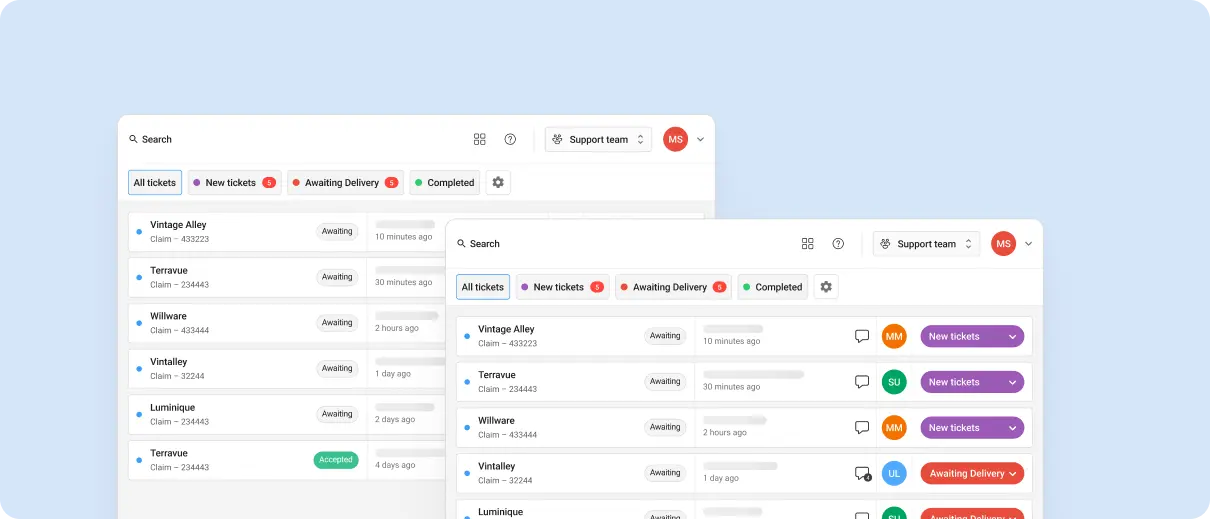
Claimlane helps retailers and brands manage returns and warranty claims without relying on long email threads and spreadsheets.
Customers can submit everything through a self-service portal, including photos, receipts and order details, so the support team has what they need from the start.
Claimlane also connects with ecommerce platforms, carriers and ERP systems, so things like refunds, return labels and supplier communication can be handled as part of the same process.
Role: Marketing Specialist
I work in a small marketing team, which means my role covers quite a lot.
I work across automation, SEO, content, webinars, outbound, video and internal tools. A big part of the job is also spotting things we are doing manually and figuring out whether there is a better way to do them.
Whenever possible, I try to build things that the rest of the team can keep using without needing me to run them.
Key responsibilities
Marketing automation
Building workflows in n8n, Clay, Make and Zapier for things like lead enrichment, outbound, freemium nurture and keeping HubSpot clean.
Internal tools
Building tools the team needs, including demos, calculators and dashboards, mostly using Cloudflare Workers.
SEO and website content
Rewriting and maintaining pages in Webflow, alongside technical work on internal links, redirects, metadata and schema.
Customer research and sales enablement
Going through sales calls and customer conversations to understand what people actually care about, improve our messaging and help the SDR team find better prospects.
Webinars
Working on everything from the initial idea and finding speakers to promotion, hosting and follow-up.
Instagram and video
Running the channel and scripting, filming and editing short-form videos.
LinkedIn and ghostwriting
Planning the content calendar and writing posts for Claimlane and members of the leadership team.
AI product launches
Running marketing around Claimlane's AI Agent across campaigns, content and launch material.
Outbound data
Using tools like Apify, RB2B and Clay to find, enrich and qualify companies before sending them into Heyreach and Instantly.
Tool evaluation
Testing new tools, figuring out whether they are actually useful and getting the good ones into production quickly.
Freelancers and agencies
Finding and working with freelancers on design, graphics, video, copy and technical projects, and briefing and managing an external SEO agency.
Growth impact
A few of the numbers from the period I've been part of the team.
Business impact
+95%
Lead growth
+122%
Increase in SDR meetings
+64%
Monthly revenue growth
1 → 2M
ARR growth
70 → 100+
Customers
SEO
4.5×
Organic keywords ranked
~8.5×
Estimated organic traffic
10 / 20
Top keywords cited in Google AI Overviews
355+
Blog articles shipped in a year
Selected builds
A few projects I've worked on at Claimlane and the problems they were meant to solve.
Product / Lead generation
Let prospects see Claimlane with their own products
It is one thing to show someone a generic product demo. It is much easier to understand when it looks like your own business.
So I built a tool where you can enter a store URL and get a working Claimlane portal using that company's logo and products.
There are two versions. One lives on the website and captures leads in HubSpot. The other is used by sales, so they can create a personalised version and send it directly to a prospect.
We also send activity to Slack, which means the sales team can see when someone has actually opened the demo.
Cloudflare Workers
KV
Vanilla JS
HubSpot
Slack
See what your self-service portal could look like
Enter your store and we'll show you a Claimlane portal using your brand and products.
Enter your store URL
Back Help
Select your product
Select the products you want to claim
Building the portal…
Lead generation
A pricing-page ROI calculator that pays back its build cost
Four sliders, one email gate, a real number at the end. Prospects on the pricing page get a personalised savings estimate — and we get a lead qualified before the SDR ever picks up the phone.
Submissions land in HubSpot with hidden lead-source fields, a personalised PDF report goes out on submit, and the ROI signal was wired into our lead scoring within a week of launch.
Vanilla JS
HubSpot
MQL scoring
Slack
Your current setup
500
5010,000
20 min
5 min90 min
$25
$15$75
65%
Avg.
1%100%
Estimated annual savings
$63,700
Based on 65% automation, average across customers
SEO
Reworking 160+ pages and changing how we approached SEO
We had more than 160 pages that needed attention, so I worked through them one by one.
The goal was not just to rewrite the copy. We introduced clearer rules around how pages should be built: use real customer examples, verify internal links, remove unsupported claims and avoid the language that makes B2B content all sound the same.
We also reduced our publishing pace from around 20 articles a week to roughly six.
Publishing more was not necessarily helping. In several cases, we were creating pages that competed with each other for the same searches.
Alongside the content work, I worked through technical SEO issues including broken links, redirects, metadata and schema, and briefed the external SEO agency we work with.
Semrush
Webflow
Claude
Notion
SEO / AI content
Shipping 350+ articles in a year without losing our voice
We started at ~5 blog posts a month written by hand. That didn't scale to the SEO ambition we had.
So I built the pipeline: Semrush pulls 6,000+ target keywords → a Notion writing agent drafts each one using our tone of voice and internal-link rules → drafts land in Webflow with FAQ schema and cluster tagging → I QA and publish.
At peak it ran 10 articles a week; May 2026 was a 77-article month. Around 355 posts landed during the year, and 18 of Claimlane's top-20 traffic keywords now live on pages this system produced.
Semrush
Semrush MCP
Notion
Claude
Webflow
n8n
AI search visibility
Getting cited inside Google AI Overviews, on purpose
In October 2025 I added an llms.txt to the site and started the schema markup work. Most B2B marketers hadn't heard of GEO yet; I wanted us in the answer set when buyers stopped clicking blue links.
In May 2026 I put together the AI Visibility Action Map: 45 real buyer prompts, 22 topic clusters, and a rewrite pass on the top money pages to match how AI answer engines assemble responses.
Result: Claimlane is now cited inside Google AI Overviews on 10 of its top-20 US keywords, including "warranty management software", "rma number", "delivery exception" and "ecommerce returns".
llms.txt
JSON-LD schema
Claude
Manual prompt research
Marketing ops
Turning sales calls into useful feedback automatically
We record a lot of sales calls, but there is only so much time managers can spend listening back to them.
I built a workflow that takes each recorded call, reviews it against the sales framework we use and sends a short summary to Slack. The relevant notes are also added back to HubSpot.
That gives reps feedback while the conversation is still fresh instead of weeks or months later.
I've built several smaller workflows around the same idea, including meeting preparation, lead screening, enrichment and weekly growth reporting.
I've found that the simplest automations are often the ones that end up being the most useful.
n8n
Fireflies
Anthropic API
HubSpot
Slack
What happens to a call after it's recorded.
Research
What we learned from more than 600 sales calls
We had years of recorded sales calls, but we had never really looked at them together.
So I went through more than 600 conversations and pulled out the moments where prospects talked about their problems, frustrations and reasons for looking for something new.
A few themes kept coming up.
People rarely said, "We need returns software."
They talked about not knowing what was happening with a case. Spending too much time on manual work. Moving information between systems. Sending too many emails. Or losing customers because a warranty claim had been handled badly.
Those findings helped shape both our website messaging and the companies our SDR team focused on.
Python
Fireflies
Claude
Paid experiments
One of the first B2B teams to run ChatGPT ads
OpenAI opened Ads Manager for advertisers in June 2026. I had Claimlane's account set up on day one and started designing tests immediately.
July was the first proper run: 6 campaigns, email-account targeting, full conversion tracking wired to our attribution stack. August was a conversion-quality pass — figuring out which of the leads that clicked actually behaved like real prospects vs. curiosity clicks.
Most B2B marketers are sitting on the sidelines waiting for case studies. Being early gives us weeks of learning on a channel that's about to get very expensive.
OpenAI Ads Manager
GA4
HubSpot conversion tracking
Brand
Making it easier for everyone to create on-brand material
Our decks and one-pagers were starting to look slightly different depending on who made them.
Different blues. Different type sizes. Old screenshots. Old logos.
So I helped set up a simple design system in Figma with shared colours, typography and reusable assets.
I also created templates that sales can duplicate and edit themselves instead of needing someone from marketing every time they want to change a slide.
A lot of the repetitive Figma work was done through the API rather than manually.
Figma
MCP
Figma Plugin API
Internal AI
Helping the team actually use AI after the first workshop
Getting people excited about AI for an afternoon is easy.
Getting them to keep using it a month later is harder.
After our first internal session, everyone had built something. The next challenge was making sure those ideas actually got used.
So I set up a simple system around it: a Slack channel for sharing, a board where everyone tracks what they are building, a backlog of ideas and a weekly session where someone shows what they made.
The most important part is sharing.
If one person builds something useful, the next person should be able to use it rather than starting again from scratch.
Notion
Slack
Claude
Last updated August 2026.
Webinars
I also work on Claimlane's webinars from start to finish, including the idea, speakers, promotion, hosting and follow-up.