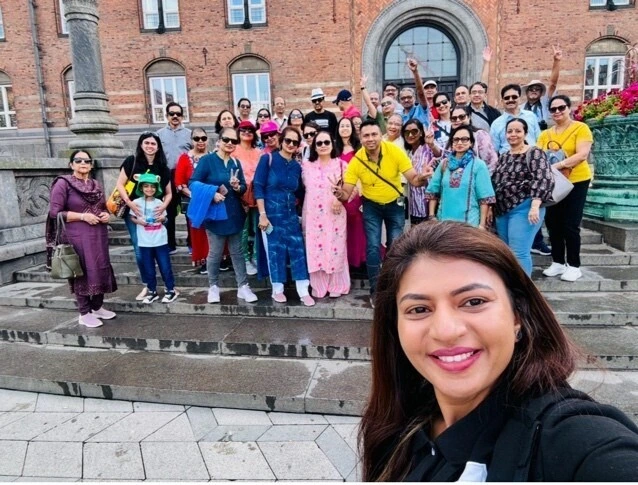
When Kiran Kurani first moved to Denmark from India, she never imagined she’d one day be leading tourists through Copenhagen’s royal halls and cobbled streets in four languages. Today, she’s not just a certified guide, but the first Indian to be licensed as a professional tour guide in all of Scandinavia.
“What truly motivated me to become a guide was my love for history, culture, and connecting with people,” Kiran explains. “I realized that as someone with a multicultural background, I had a unique perspective to offer.”
Like Kurani, many others have stumbled upon tour guiding as a career path, first doing it out of necessity maybe, and afterwards choosing it as a professional path. Most of the time, it ends up as something genuinely rewarding.
How do people start doing it?
As one anonymous interviewee shared with Last Week in Denmark:
“After sending 100+ job applications with no luck, I saw a ‘guides wanted’ ad. The pay wasn’t great, but it beat unemployment. Two years later, I’m still doing it while looking for other jobs.”
This might sound familiar, but you’re not alone. For many internationals, tour guiding might not be the first choice when they come to Denmark. But, considering the benefits (flexible hours, extra income), the majority of people who start doing it, end up staying longer than they expected.
Mark Jorritsma, who worked with Segway Tours and Free Walking Tours Copenhagen, discovered tour guiding through an internship: “Once I started at Segway Tours Copenhagen, I learned everything about the city, the history, the Danish culture. I completely fell in love with it,” he says.
What does the work actually imply?
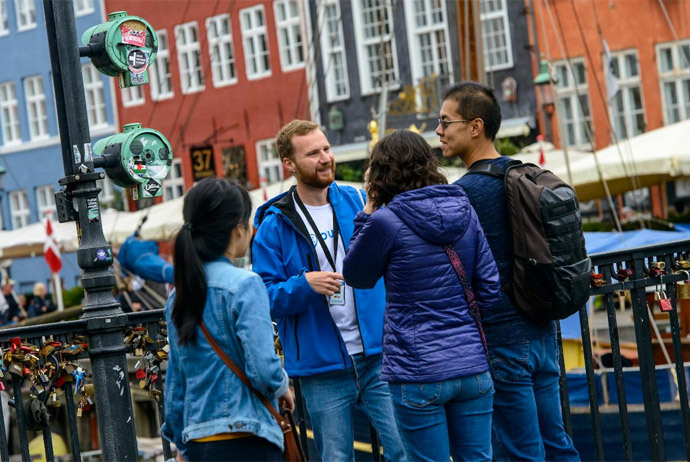
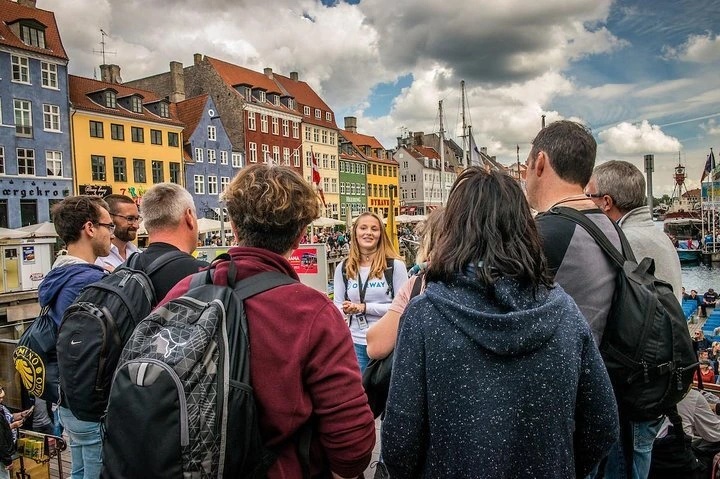
Traditional walking tours. These tours involve leading groups around city centers, explaining history and pointing out landmarks. Think Copenhagen’s Old town or Aarhus’s Viking sites.
Food tours are huge here. Companies like FoodTours.eu focus entirely on combining local cuisine with cultural stories. As their General Manager Simon Presley puts it: “We generally hire based on a person’s ability to connect with people and their passion for food.”
Platforms like Airbnb allow for the creation of unique, niche touring experiences.
Another option is private guiding. This option is proving to be quite common in terms of helping cruise ship passengers, business conference groups or smaller groups who are looking for a more personal touch.
For more adventurous tourists, Segway and bike tours offer a unique perspective over what’s the biking experience locally, while learning about the landmarks at the same time.
Honestly, no two days are exactly alike. One minute you could be explaining why Danes are okay with leaving their babies in strollers outside cafes, and the next you’re deep into Viking sagas or trying to explain what hygge really means, far beyond what you see on Instagram. This is the rewarding component of working in this domain.
What Can You Actually Earn?
There’s no straight answer, as there are multiple variants that come into play.
Free walking tours? The main source of income here comes from customers’ tips. You might see €10-30 per head, but you can’t count on that every single tour. You might have very successful days, and others that don’t amount to much.
With Airbnb experiences, you get to keep about 80% of what you charge, giving you more control over your earnings.
Private tours usually pay more per hour, but the availability of gigs can be unpredictable.
Like one guide at DMC Nordic said: “This is a typical freelance job. However, many guides have a good income during the high season. You can fill up your calendar with various guide jobs if you complete our Level 1 and 2 courses.”
The reality is that most guides combine their income from different sources – perhaps regular tours, some private work, and possibly seasonal contracts with tour companies.
Do You Need to Speak Danish?
Not necessarily, at least not fluently.
Mustapha A. from Enjoy the Tours explains their approach: “Danish language helps, but isn’t required. We welcome international applicants, valuing enthusiasm, communication skills, and a passion for local culture over formal certifications.”
That said, Mark Jorritsma found language was still a challenge: “Not being able to speak Danish was definitely a challenge. Also, showing Danes around their own city: that can be tricky. Their knowledge is often very good, and it’s not always easy being the foreigner telling them about their own culture.”
Most international tours, focused on international visitors, are conducted in English. However, many companies are interested in hiring individuals who can speak multiple languages.
Do you really need certification?
Technically speaking, anyone can start doing tours in Denmark. But getting certified through the Danish Tourist Guide Association (FTG) adds credibility and leads to more opportunities.
Simon Presley, General Manager at FoodTours.eu explains: “Applicants, be they Danish or international, do not need to be certified tour guides in our company. This is because food tours like ours do not require that, which we’ve confirmed with the local guides’ association. It obviously doesn’t hurt an applicant’s chances if they’re certified, though.”
Here’s when getting certified is a good idea:
- If you want to work with well-known tour companies that tend to prefer certified guides.
- It helps you build trust with your clients.
- You’ll likely have more job options available to you.
- It gives you official recognition within the tour guide branch.
And here’s when you might consider holding off on certification (for now):
- If you’re just starting out with free walking tours or through platforms like Airbnb experiences.
- If you’re still trying to figure out if you actually enjoy being a tour guide.
- If you’re looking at companies that care more about your personality and enthusiasm than official papers.
The Certification Process
If you do decide to go the official route, here’s what you’re looking at:
Most programs involve completing an official education. There’s a one-year program at Roskilde University. You’ll need to pass exams on Danish history, culture, and communication skills, and demonstrate language proficiency on top of that.
DMC Nordic started their own Nordic Guide Academy because there’s actually a shortage of trained guides in Copenhagen. Their course involves an 8 month program, which covers Danish history, culture, storytelling & microphone techniques, and communication skills improvement. It is open to English speakers, no Danish language skills required.
Kiran decided to get the certification: “I began by learning about Danish history and architecture, studying intensely, and volunteering where I could. Eventually, I enrolled in professional training, completed the required certification, and proudly received my guiding license.”
What You Actually Need to Know
While learning every single fact about Danish ancestry might be tempting, that might prove to be a bit too much at the beginning. What tourists might really look for are stories they can relate to and hidden facts you cannot find easily on Google.
One guide told Last Week in Denmark: “For a lot of us, very in-depth knowledge is not important because we only spend a few hours with the tourists. You don’t need to go deep into Danish history. In my case, I would say that I need to understand and connect facts to be able to explain.”
In a nutshell what needs are:
- Entertaining, easy-to-relate anecdotes.
- Addressing cultural nuances.
- Hidden gems: where do locals actually grab a bite, steering clear of tourist traps?
- Merging history and the present to offer a unique perspective.
Pro tip: Check out the “Historien om Danmark” documentary series. It’s a painless way to grasp the big picture without getting lost in the details.
Testing the waters
Before starting to invest in courses and other resources, it might be wise to try one of the following:
Companies like Copenhagen Free Walking Tours hire English speakers and let you learn while earning through tips.
Airbnb, through its experiences program, is an easy gateway into doing something like this with no strings attached. Think about how you could make it interesting, in relation to your background and interests.
Go on a few tours which are already taking place. Don’t hesitate to contact local tour companies, be it for advice or asking for extra information for getting started. Many are quite open to this.
Summer months bring a lot of tourists in the city and this might prove to be an opportunity you won’t want to miss.
Day to day life
While it might seem simple in theory, the work is more than just walking and talking. You need a high level of energy, storytelling skills and crowd control, in order to manage groups of people from different backgrounds with different energy levels.
Mark describes the reality: “It’s an amazing job if you love it. No day is the same, and meeting so many different people is incredible. But it can be tough too. Your social battery takes a hit, and you have to work when everyone else is off.”
He also learned this valuable lesson: “One thing I learned is that it’s okay to be silent sometimes: just let people enjoy the city. You don’t have to be ‘on’ all the time.”
The training process varies by company, but Simon describes a typical approach at FoodTours.eu: “New guides get a training manual, then join a tour as a guest with a colleague. After that, they run their own first tour with either me or our assistant manager present as support. If things go well, they’re good to go.”
The Challenges You Should Know About
Kiran faced significant challenges: “As a non-Danish national, finding my footing in a traditionally Danish industry was not easy. I faced skepticism, language barriers, and self-doubt.”
For Kiran, the situation was unique: “I’m a proud mother of two: I have an 11-year-old daughter and my 7-year-old son who has special needs. There were days when I felt stretched to my limit, but I had one powerful ally, my husband. His support allowed me to follow my dream.”
The practical problems include:
- Money isn’t steady, especially when you start
- Weather, especially in Denmark, might prove unpredictable at times
- Working with very different individuals from different cultures might prove challenging at times
- The need of a high level of energy all day
- Winter months may prove to be slower
Why Your International Background Is Actually an Asset
FoodTours.eu has 14 people, 9 Danish and 5 foreign, and Simon notes that even several of the Danes have partially foreign backgrounds.
Kiran realized her multicultural perspective was a strength: “Don’t let your background hold you back, let it be your strength. Learn, adapt, be curious, and above all, stay true to your voice.”
One anonymous guide explains why this matters: “Obviously, there are different kinds of tourists, but most of them appreciate knowing and understanding Denmark better. They like to hear about daily life. For this reason, I consider it important to connect the past with the present.”
Bringing an outside perspective in tour guiding is highly valued, as it allows you to touch upon subjects or details that might be overlooked by natives. Moving to another country is a whole process, with problems, questions and sometimes difficult situations. All of these offer a new perspective when talking about a place, which allows international guides to connect with tourists on a more personal level.
How do you get started
- Begin by doing thorough research. Some online resources in this direction would be Visit Denmark, the FTG, or an online course about Danish history and culture.
- Get comfortable with speaking in front of an audience. This doesn’t come naturally to a lot of people so don’t feel embarrassed about feeling embarrassed! You can practise it before with your friends or family.
- Try to build a network. There are many who have done it before you. Thus, platforms like Linkedin or Facebook are your best friends.
- Try one test tour. As one freelance guide in Copenhagen advises: “Try it before investing in courses. I started with one test tour, now it’s my bridge to better opportunities.”
- Think about why you want to do it. If you’re looking at this as a break from job hunting, with the possibility of earning some extra income and having fun on the side, that’s completely valid.
Bottom line. Is it worth it?
Most people that have spoken to Last Week in Denmark about this subject, tend to agree. Mark, whose journey was interrupted by the pandemic, still says: “Overall it was amazing to do, and I’m so happy I did it.”
The anonymous guide who started out of necessity admits: “Once I started doing it, I learned to like and enjoy it, but still, it is not my calling.” And that’s okay too: not everything has to be your life’s passion to be worthwhile.
DMC Nordic: “You need to be dedicated to this profession. Hospitality, guiding skills, and knowledge are essential, and you have to accept the fact that you will never stop learning and improving.”
Simon from FoodTours.eu sees growing demand in the market: “Demand for guided tours definitely seems to be booming.”
For internationals, this field of work offers more than just an extra source of income. It offers the opportunity to learn about Denmark, connect with the culture and build confidence.
As Kiran says: “To anyone thinking of becoming a tour guide in a foreign country: Don’t let your background stop you. Use it as your strength.”
Tour guiding in Denmark is a way to find your place, while helping others discover what you’ve learnt to love about this country. With growing demand in the market and companies looking for diverse voices, now might be the perfect time to try it.